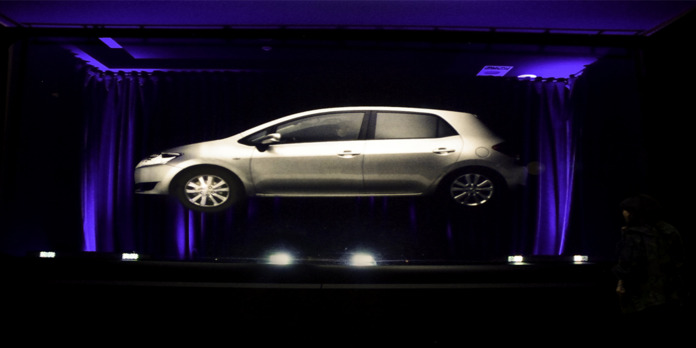
Holographic glass is a fascinating material at the intersection of optics, art, and technology. It’s not glass in the traditional sense, but a specialized medium used to display holograms.
What is Holographic Glass?
It’s typically a sheet of glass or acrylic that has a holographic optical element (HOE) or holographic film laminated onto it or embedded within it. The “hologram” is a recorded interference pattern that diffracts light to create a three-dimensional image.
How It Works (The Core Idea)
- Recording: A hologram is first created using a laser to record the interference pattern of light reflected from an object onto a light-sensitive holographic film (often photopolymer or silver halide).
- Transfer/Application: This holographic film is then laminated between layers of glass, or the interference pattern is directly etched/embossed onto the glass surface.
- Viewing: When light (from the sun, a spotlight, or an LED) hits the glass at the right angle, the holographic layer diffracts the light, reconstructing the 3D image for the viewer.
Key Types & Applications
1. Decorative & Architectural Glass
- Feature Walls, Partitions, and Railings: Creates stunning, dynamic visual effects that change with the viewer’s perspective and lighting. Used in luxury retail, hotels, and high-end residences.
- Art Installations: Artists use it to create immersive, light-based works.
- Signage & Branding: Eye-catching storefront logos or directional signs that seem to float in mid-air.
2. Security & Authentication
- High-Security ID Cards, Passports, and Banknotes: The hologram is extremely difficult to forge. Embedded in a transparent window (glass-like layer) for verification.
- Product Authentication: Used on labels for pharmaceuticals, electronics, and luxury goods to prevent counterfeiting.
3. Display & Retail
- Point-of-Sale Displays: Creates captivating product visuals (e.g., a floating shoe or perfume bottle) to attract attention.
- Museum & Exhibit Displays: Can show artifacts or reconstructions in 3D without a physical object.
4. Optical & Technical Applications
- Head-Up Displays (HUDs): In cars and aircraft, a holographic glass combiner reflects projected information (speed, navigation) directly into the driver’s line of sight, superimposed on the real world.
- Augmented Reality (AR) Waveguides: This is a cutting-edge application. Holographic optical elements are used in AR glasses (like Microsoft HoloLens or Magic Leap) to “pipe” light from a micro-projector into the user’s eye, overlaying digital images onto the real world. The glass here acts as a transparent waveguide.
Benefits & Characteristics
- Transparency: Can be mostly see-through when not activated by a light source.
- Depth & Realism: Creates true optical 3D effects with parallax (the image changes as you move).
- Durability: Laminating the hologram between glass sheets protects it from scratches and environmental damage.
- Security: Extremely complex to replicate, making it ideal for anti-counterfeiting.
- Dynamic Visual Impact: The appearance changes dramatically with lighting and viewing angle.