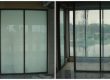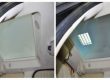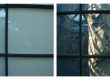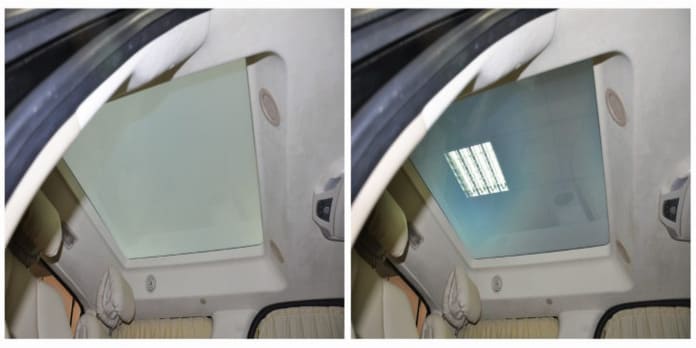
For automotive applications, smart PDLC film has evolved significantly beyond simple privacy switching. Recent innovations focus on solving key pain points for vehicle manufacturers and drivers—heat rejection, clarity, response speed, and visual aesthetics. Here are the most noteworthy new developments.
1. PDCLC (Polymer Dispersed Cholesteric Liquid Crystal) – The Black-State Revolution
Traditional PDLC films appear milky white or frosted in the off-state, which clashes with automotive interior aesthetics. The breakthrough PDCLC technology achieves a deep black, neutral appearance when off, matching the premium look of luxury vehicle interiors .
Performance benchmarks (Haiyiwei “Ink Shadow Instant Light” product):
| Specification | Value | Advantage |
|---|---|---|
| Response Speed | 5 milliseconds | 40x faster than human blink |
| UV Blocking | 99.99% | SPF130+, PA++++ rating |
| IR Heat Rejection | 90% | Reduces cooling load significantly |
| Haze (Transparent) | ≤2% | Exceptional clarity |
| Contrast Ratio | 8x (current) / 40x (lab) | Sharper on/off differentiation |
By early 2025, this technology had already completed mass production for vehicles like the Zhiji L6 (panoramic sunroof) and Yangwang U8L (rear side windows), with market orders shifting entirely toward black-state products .
2. Dynamic Zone Control & Smart Dimming
Instead of a single on/off state for the entire glass surface, advanced films now support partitioned, independent control. The vehicle can automatically adjust specific sections based on sunlight intensity—keeping the driver’s view clear while creating privacy or shading for passengers .
Control capabilities include:
- 10-level manual dimming – Fine-tune transparency to preference
- Automatic sunlight response – Film adjusts without driver intervention
- Front/rear zone independence – Different opacity levels for different seating areas
This turns the sunroof from a passive glass panel into an active smart surface that enhances comfort and energy efficiency.
3. True Energy Efficiency – Active Solar Heat Rejection
Unlike earlier PDLC films that offered limited IR protection, modern automotive-grade products achieve 90% infrared blocking through a dual mechanism: scattering within the liquid crystal micro-structure plus absorption by the polymer matrix .
Real-world thermal performance:
- Under 2.5 hours of standard sunlight exposure, interior temperature is 7–10°C (12.6–18°F) lower than conventional glass roofs
- Reduces air conditioning energy consumption by 17% compared to traditional sunroof solutions
This directly addresses the “baking hot” complaint common among panoramic glass roof owners.
4. Reverse-Mode PDLC – Fail-Clear Safety
A significant safety innovation is reverse-mode PDLC, which is transparent when power is OFF and becomes opaque only when voltage is applied .
Why this matters for automotive:
- Fail-clear operation – If the vehicle’s electrical system fails, the glass remains transparent for safe driving
- Progressive dimming – Continuous adjustment from clear to opaque, not just two states
- Lower power consumption when maintaining transparency (the default driving state)
This technology is particularly relevant for side windows and windshield applications where safety cannot be compromised.
5. Curved Glass Compatibility
Modern vehicles feature complex curved glass designs, and smart films have evolved to match. Advanced PDLC films are engineered with sufficient flexibility to conform to radii of curvature greater than 1 meter .
Installation considerations for curved applications:
- Heat-assisted installation makes the film more pliable
- Thinner, more flexible variants (e.g., PDLC Switchable Smart Back Film) are specifically designed for automotive curves
- Laminated versions integrated into double-glazed units offer better durability for curved panoramic roofs
6. Ultra-Low Haze – Crystal Clear Transparency
One historical complaint about PDLC was the “milky” look in transparent mode. Premium automotive-grade films now achieve on-axis haze of just 2.5% with transmittance around 80% .
Technical nuance: Off-axis haze (viewing from an angle) remains higher due to PDLC’s inherent structure, but leading manufacturers have minimized this through improved polymer matrix design . For reference, the “opaque” state achieves 80–95% haze, providing excellent privacy without complete blackout .
7. Mass Production Cost Reduction
The most commercially significant development: PDCLC mass production costs are now 40% lower than imported alternatives, with yield rates reaching 92% . More than five major automakers (including SAIC and BYD) have already adopted the technology for production vehicles .
Technology Comparison for Automotive Use
| Feature | Traditional PDLC | PDCLC (New) | SPD | Electrochromic |
|---|---|---|---|---|
| Off-state appearance | Milky white | Deep black | Dark blue/grey | Dark blue/grey |
| Response speed | 0.3–2 seconds | 5 milliseconds | 1–3 seconds | 30–60 seconds |
| UV protection | Limited | 99.99% | Good | Good |
| IR heat rejection | Limited | 90% | Good | Moderate |
| Transparent haze | 5–10% | ≤2% | 1–3% | 1–5% |
| Power to stay clear | Always required | Required (see note) | Switch only | Switch only |
| Automotive proven | Yes | Yes (2025+) | Yes | Emerging |
Note: Reverse-mode PDLC can be fail-clear, but standard PDLC and PDCLC require continuous power to maintain transparency .